Environmental Monitoring of Present and Reconstruction of Past Tritium Emissions from the National Tritium Labeling Facility at the Lawrence Berkeley National Laboratory, California
(March 2007 Report - 81MB PDF)
Roger Byrne
Geography Department,
University of California, Berkeley
Pamela Sihvola
Committee to Minimize Toxic Waste
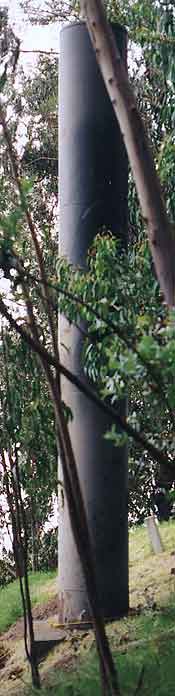
The National Tritium Labeling Facility (NTLF) was located on the eastern edge of the Lawrence Berkeley National Laboratory (LBNL) in Building 75. Just to the north of the NTLF is the Lawrence Hall of Science, a popular children's science museum that is visited by thousands of children every year. The NTLF was established in 1982 as a National User Facility for the labeling of compounds used in pharmaceutical and biological research. The tritiation of these compounds involved an inefficient exchange process that required the use of large quantities of tritium (the radioactive form of hydrogen), i.e., 100+ curies of tritium per tritiation and therefore thousands of curies per year. Commercial tritium facilities can not produce tritiated compounds in this way because Federal Regulations limit them to a total inventory of only 150 curies of tritium. Department of Energy Facilities, in contrast, can have much larger inventories. The NTLF's inventory limit, for example, was 15,000 curies.
The amount of tritium shipped out of the NTLF in tritiated compounds was avery small fraction of the total tritium used. The balance of the tritium went out either as waste or was emitted via the facility's two stacks. Tritium emissions from the NTLF's main stack were monitored on a weekly basis with a silica gelsampler and in real-time with an Overhoff system.
 The silica gel data were used to estimate the annual dose to the public to ensure compliance with National Emissions Standards for Hazardous Air Pollutants (NESHAPs) requirements. Dose estimates were modeled with CAP88, a computer program approved by the US Environmental Protection Agency (US EPA).
The public first became aware that tritium was being released into the environment by the NTLF in the early 1990's. However, at that time very little was known about the nature of the problem. In 1996 community concerns regarding the NTLF began to escalate when Dr. Leticia Menchaca, an LBNL researcher who had been investigating tritium in the area close to the NTLF, reported that the levels were higher than had been previously reported. Community concern was further increased when Susan Monheit, another LBNL employee, produced a master's thesis which showed that the levels of tritium in plants, soils, and rain near the NTLF stack were unexpectedly high. She also reported above background tritium activity in rainfall samples collected 3.8 kilometers from the stack. In the same year, some community members independently collected water samples from Eucalyptus trees between the NTLF stack and the Lawrence Hall of Science and also found that tritium activity levels were unexpectedly high. In addition, Dr. Menchaca analyzed the organically bound tritium activity in Eucalyptus leaves collected in the area around the NTLF stack and again found very high levels, especially in the area between the stack and the Lawrence Hall of Science. Shortly afterwards both Dr. Menchaca and Ms. Monheit were laid off at LBNL.
 Another cause for community concern was the publication of a paper by Dr. Tore Straume (1995) in which he pointed out that there is an inverse relationship between the energy level of radiation and its biological effectiveness. He also stated that the biological effects of tritium beta rays were likely to be substantially larger, i.e. 4 to 5 times larger, than previously thought.
In September of 2001 the National Institutes of Health announced that they would discontinue funding the National Tritium Labeling Facility (NTLF). Shortly afterwards Lawrence Berkeley National Laboratory (LBNL) announced the Facility would be closed by the end of December 2001 and that the process of decommissioning and clean up would begin afterwards. However, the NTLF remained operational through mid-June 2002, while the oxidation of tritiated mixed waste continued. The decision to close the NTLF at LBNL was welcomed by community members who had been concerned about tritium emissions since the early 1990’s. In fact in 1998 the US Environmental Protection Agency (USEPA) performed a Superfund reassessment of LBNL concluding that “Basedupon a preliminary Hazard Ranking System score, US EPA has determined that LBNL is eligible for the National Superfund Priorities List” for cleanup, due to tritium in air, soil, groundwater, and surface water.
 In June of 2005 a National Academy of Sciences panel, formally known as the Committee on Biological Effects of Ionizing Radiation (BEIR), concluded that there is no exposure level found below which dosage of radiation is harmless. The preponderance of scientific evidence shows that even very low doses of radiation pose a risk of cancer or other health problems. The National Academy of Sciences panel is viewed as critical because it addresses radiation amounts commonly used in medical treatment and is likely to also influence the radiation levels that the government will allow at abandoned and other nuclear sites.
Report Organization
The research effort reported on here has three primary objectives: 1) to monitor tritium activity levels in rainfall near the Lawrence Hall of Science, and creeks draining the watersheds close to the NTLF stack; 2) to date wood samples from Eucalyptus trees growing between the NTLF stack and the Lawrence Hall of Science; and, 3) to determine the organically bound tritium content of the dated samples as a means of reconstructing tritium emissions from the NTLF Stack. These three objectives are covered in Part A, Part B, and Part C of this report.
Home | Contaminant Plumes | Plume Maps | Tritium Release Reconstruction | Full Reports